
Measuring Decarbonisation Impact of Energy Communities
This article describes the Carbon Footprint and the Carbon Savings, key performance indicators to assess the CO₂-equivalent emissions and their reduction for an energy community, developed by Grid Singularity in the framework of the EU co-financed ThumbsUp project.


Introduction: Why Performance Indicators Matter in the Energy Transition
Energy communities, whether organized as microgrids, self-consumption schemes or more advanced frameworks for local and flexibility trading, help reduce the overall carbon footprint, or more accurately the CO₂-equivalent emissions. This is achieved by a more optimal use of renewable and flexible resources, leading to their higher rentability and incentivising increased citizen and business investment in energy transition.
One important measure of this contribution relates to the higher self-consumption rate, as demonstrated both by scientific research(1) and previous studies undertaken by Grid Singularity(2). Improved visibility and management of distributed energy resources also enhances grid resilience, providing wider system support to greener, more effective energy management.
Establishing the appropriate Key Performance Indicators (KPIs) is essential to effectively track and accelerate decarbonisation efforts. Without clear and measurable benchmarks, it's difficult to identify what works, where to invest, and how to optimize strategies for maximum climate benefit. Specific decarbonisation KPIs are vital to understanding the environmental impact of energy communities and more broadly the impact of use and optimisation of energy assets, especially considering significant evidence indicating a lack of performance measurements in this domain(3).
Researchers have focused their attention on improving the performance indicators to evaluate the energy transition. For instance, Juan et al highlight their importance, relying on studies conducted in the framework of the UP2030 project, a European initiative focused on defining performance indicators to aid pilot cities in their transition towards achieving climate-neutral objectives, concluding:
“The availability of updated KPI data for monitoring and predictive purposes is particularly critical for cities aspiring to become smarter and more sustainable.” (4)
Decarbonisation indicators are also required for a more comprehensive environmental impact assessment in the framework of the ThumbsUp project, which facilitates the development of innovative, thermal energy storage technologies that can easily be integrated into buildings to increase their energy efficiency and grid flexibility.
Putting this into practice, Grid Singularity (GSY) develops tools to simulate and assess the benefits of energy trading (see the GSY Singularity Map – also termed Local Energy Market Simulation Tool), and to operate and manage energy communities with its Social Community Manager. With the support of the ThumbsUp project, GSY developed two decarbonisation matrices and integrated them in its simulation tool to support environmental impact evaluation of local energy trading. This includes planned assessment of innovative solutions developed in the project related to heat pump storage performance, applicable to a local energy community (also termed microgrid and otherwise depending on applicable legislation). For this, two key indicators have come into focus: Carbon Footprint and Carbon Savings - together, they provide a clear picture of progress toward decarbonisation goals.
Carbon Footprint
This KPI measures the total emissions of a community by correlating the imported electricity with the average CO₂-equivalent emissions of the country of location expressed in kilograms (kg) of CO₂ equivalents per kWh.
The carbon footprint value is calculated as follows:
Carbon Footprint (kg CO₂-equivalent) = Imported Electricity (kWh) × Country’s CO₂-equivalent Emissions (kg CO₂-equivalent/kWh) / 1000
Note that terms country and entity are used intermittently in this article and the relevant development documentation to avoid any political implications.
Carbon Savings
This KPI represents the reduction in carbon footprint resulting from a decrease in electricity imports realised by engaging in community energy trading.
The carbon savings value is calculated as follows:
Carbon Savings (kg CO₂-equivalent) = Baseline Carbon Footprint − Reduced Carbon Footprint
The two developed decarbonisation metrics are calculated over a defined time frame (daily or monthly) and exclusively at a community level, considering that the imported electricity composition is not readily available for each community participant but approximated based on country-level electricity consumption emissions as explained above.
Calculating Carbon Intensity with Open Data
Significant part of the development effort pertains to selecting reliable and freely available data sources for country/entity-level emissions and completing the related API integration. The emissions data for most European countries is calculated based on real-time values retrieved from the European Network of Transmission System Operators for Electricity - ENTSO-E’s Transparency Platform API. The platform provides the actual generation per production type on an hourly basis. The carbon intensity for each country is obtained by multiplying the energy generated by the appropriate electricity supply technology emission factor (EF) from Climate Change 2014: Mitigation of Climate Change. The sum of these products gives the hour’s total CO₂-equivalent emissions, and dividing by total electricity generated yields the carbon intensity, based on the following formula:
Country Carbon Intensity (kg CO₂-equivalent/kWh) = [(Energy Fossil Gas (kWh) × EF Gas (kgCO₂-equivalent/kWh)) + (Energy Biomass × EF Biomass) + … + (Energy Solar × EF Solar)] / (Energy Fossil Gas + … + Energy Solar)
Additionally, two open-source database sources are used for retrieving CO₂-equivalent emission data for other regions, namely Electricity Maps (licenced under the Open Database License - ODbL), which provides historical data on carbon intensity of electricity generation based on a country’s energy mix, and Our World in Data (licensed under the Creative Commons Attribution 4.0 International License - CC-BY), an open-source, nonprofit organisation offering comprehensive global datasets, including carbon intensity of electricity generation. For countries or entities where direct CO₂-equivalent emissions data was not available (such as Andorra, Palau, etc.), values from neighbouring countries or regions are selected.
Finally, the world carbon footprint value is calculated as follows:
World Carbon Footprint (g CO₂-equivalent / kWh) = 540 (14.6 (total emissions) / 27000 (global electricity production)) (IEA)
The following images show example results for the developed decarbonisation KPIs as they appear in Grid Singularity’s simulation tool interface (Singularity Map), currently available for use free of charge to any registered user.
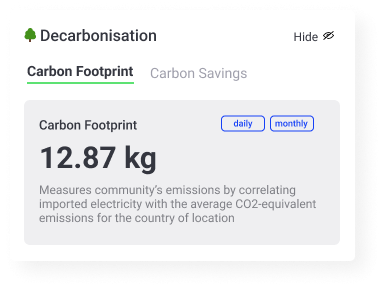
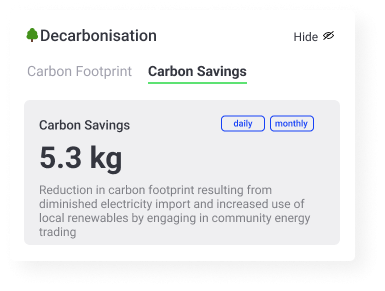
Figure 1: Example of Carbon Footprint and Carbon Savings Results in Grid Singularity’s simulation tool interface (Singularity Map)
Tracking Real Progress Towards Decarbonisation
In summary, to accelerate the energy transition citizens and businesses need to invest in renewable resources and participate in energy communities to maximise the use of these resources, enhancing energy efficiency, supporting grid resilience, and reducing CO₂-equivalent emissions. To properly measure not only their potential but also their impact, it's essential to ground these efforts in clear methodology and transparent data that yield meaningful KPIs that track real progress, such as Carbon Footprint and Carbon Savings developed by Grid Singularity in the framework of EU co-financed ThumbsUp project. By leveraging reliable data sources and integrating them into actionable insights, we can empower citizens, businesses, and policymakers to make informed decisions that drive impactful climate action.
The article has been co-authored by Spyridon Tzavikas, Hannes Diedrich, Tiago Tavares and Ana Trbovich from Grid Singularity, and Emilia Pisani Berglin from RISE Research Institutes of Sweden, based on Grid Singularity’s development in the Horizon Europe co-funded ThumbsUp project.
------------------------------------------------------
Refrences
[1] Multiple scientific articles support this claim and recognise the high potential of energy communities in optimising energy use, including Franzoi, N.; Prada, A.; Verones, S.; Baggio, P. Enhancing PV Self-Consumption through Energy Communities in Heating-Dominated Climates. Energies 2021, 14, 4165. https://doi.org/10.3390/en14144165; R. Alvaro-Hermana, J. Merino, J. Fraile-Ardanuy, S. Castaño-Solis and D. Jiménez, “Shared Self-Consumption Economic Analysis for a Residential Energy Community,” 2019 International Conference on Smart Energy Systems and Technologies (SEST), Porto, Portugal, 2019, pp. 1–6, https://doi.org/10.1109/SEST.2019.8849101.Aldo Canova, Paolo Lazzeroni, Gianmarco Lorenti, Francesco Moraglio, Adamo Porcelli, Maurizio Repetto, Decarbonizing residential energy consumption under the Italian collective self-consumption regulation, Sustainable Cities and Society, Vol. 87, 2022, 104196, ISSN 2210–6707, https://doi.org/10.1016/j.scs.2022.104196.
[2] Grid Singularity builds tools to simulate (Singularity Map) and operate energy marketplaces (Social Community Manager). For more, see multiple energy community simulation studies published in Grid Singularity Medium channel articles here: https://gridsingularity.medium.com/, with tool stack documentation available in the Grid Singularity wiki, https://gridsingularity.github.io/gsy-e/documentation/.
[3] See, for example, Fernandes J, Remédios S, Gérard F, Bačan A, Stroleny M, Drosou V, Christodoulaki R. The Decarbonisation of Heating and Cooling Following EU Directives. Energies. 2025; 18(13):3432. https://doi.org/10.3390/en18133432.
[4] Juan AA, Ammouriova M, Tsertsvadze V, Osorio C, Fuster N, Ahsini Y. Promoting Energy Efficiency and Emissions Reduction in Urban Areas with Key Performance Indicators and Data Analytics. Energies. 2023; 16(20):7195. https://doi.org/10.3390/en16207195.
[5] ThumbsUp, Horizon Europe Project supported by the European Commission under contract no. 101096921, https://www.thumbsupstorage.eu/.
[6] European Network of Transmission System Operators for Electricity — ENTSO-e’s Transparency Platform API, https://transparency.entsoe.eu/content/static_content/Static%20content/web%20api/Guide.html
[7] Schlömer S., T. Bruckner, L. Fulton, E. Hertwich, A. McKinnon, D. Perczyk, J. Roy, R. Schaeffer, R. Sims, P. Smith, and R. Wiser, 2014: Annex III: Technology-specific cost and performance parameters. In: Climate Change 2014: Mitigation of Climate Change. Contribution of Working Group III to the Fifth Assessment Report of the Intergovernmental Panel on Climate Change [Edenhofer, O., R. Pichs-Madruga, Y. Sokona, E. Farahani, S. Kadner, K. Seyboth, A. Adler, I. Baum, S. Brunner, P. Eickemeier, B. Kriemann, J. Savolainen, S. Schlömer, C. von Stechow, T. Zwickel and J.C. Minx (eds.)]. Cambridge University Press, Cambridge, United Kingdom and New York, NY, USA, https://www.ipcc.ch/site/assets/uploads/2018/02/ipcc_wg3_ar5_annex-iii.pdf
[8] Electricity Maps, https://www.electricitymaps.com/
[9] Our World in Data, https://ourworldindata.org/
[10] International Energy Agency, Global Energy Review: CO2 Emissions in 2021 Global emissions rebound sharply to highest ever level, 2022, https://iea.blob.core.windows.net/assets/c3086240-732b-4f6a-89d7-db01be018f5e/GlobalEnergyReviewCO2Emissionsin2021.pdf
Contact person
